Overview
In 2024, we launched an exit survey in the auto insurance quote flow to understand better why users were abandoning the experience before purchasing. Within a year, we collected over 42,000 responses, surfacing clear patterns of hesitation.
In 2025, we evolved this into a contextual info alert system: a real-time intervention that responds to a user’s selected exit reason with targeted, helpful messaging. This approach turned exit intent into an opportunity for re-engagement and conversion.
Goals
-
Identify why users are leaving the quote flow
-
Use real-time messaging to proactively address objections and keep users engaged
-
Increase policy conversion by converting exit intent into re-engagement moments
Collaborators
-
Product
-
Research
-
Engineering
My Role
As the lead designer, I collaborated with research, product, and engineering to interpret exit survey insights, design contextual info alerts, and integrate them cleanly within the quote flow. I crafted content tone, behavior triggers, and ensured the alerts matched our design system and accessibility standards.
Timeline
-
Exit survey launched: 2024
-
Info alert intervention added: Mid 2025
-
Data snapshot analyzed: July 2025
The Challenge
Business Need
-
We knew users were dropping off, but needed structured data to understand why and a way to address those concerns without breaking the flow or being too pushy.
User Need
-
Users often leave for solvable reasons such as unclear timing, pricing questions, or needing more information. Instead of letting them go uninformed, we wanted to provide answers that might change their decision.
Problem to Solve
How might we prevent users from abandoning the quote flow by proactively addressing their specific concerns right when they tell us why they’re leaving?
Discover & Define
In 2024, we rolled out a single-question exit survey for users attempting to leave the quote flow
Discover
Since inception, we collected over 42,000 responses, including free-form responses such as:
-
“My policy doesn’t expire yet”
-
“I need more time to decide”
-
“The price is too high”
Define
-
Mapped recurring drop-off reasons into categories (timing, indecision, pricing).
-
Framed opportunity: transform exit feedback into real-time re-engagement.
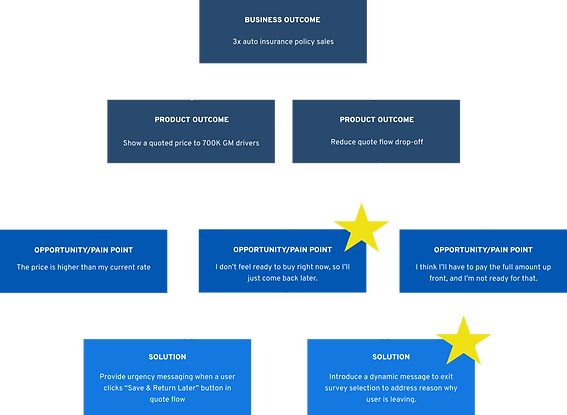
Opportunity Solution Tree
A visual is a tool that supports product discovery by illustrating the path from the desired outcome to validating solutions
Develop & Deliver
Develop
-
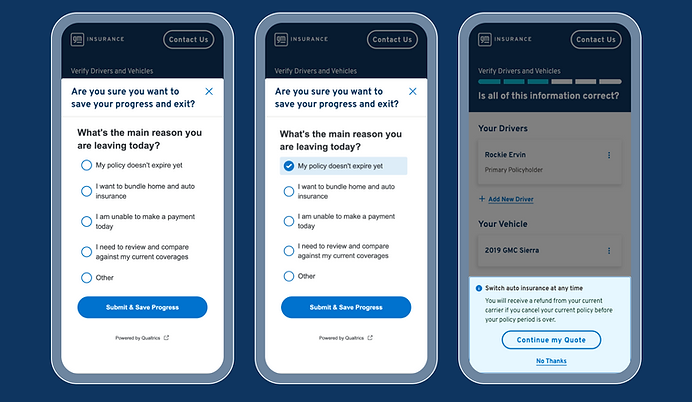
Designed a contextual info alert system:
-
Alerts triggered immediately after a user selects an exit reason.
-
Messaging targeted to the concern, e.g.:
-
Exit Reason: “My policy doesn’t expire yet.”
-
Alert Response: “You can switch auto insurance anytime. Your current carrier will refund the unused portion of your policy.”
-
-
Tone: informative, not pushy.
-
-
Ensured alerts were:
-
Seamless: appeared in-line within the quote flow.
-
Accessible: aligned with design system standards.
-
Trust-building: personalized messaging designed to reduce friction.
-
Deliver
-
Partnered with engineering to integrate alerts into the existing quote flow.
-
Conducted usability testing to ensure alerts felt natural and not disruptive.
High-Fidelity Instant Quote Flow
Results
As of July 2025
-
10% of digital policy sales came from users who had interacted with the exit survey.
-
5% of all digital sales came directly from users who saw an info alert and re-entered the quote flow.
-
Confirmed that well-timed, context-specific messaging can change user behavior and recover conversions.
Reflection & Next Steps
-
Key Learning: Users are more open to persuasion when messaging is timely, contextual, and empathetic.
-
Leadership Impact: Demonstrated how qualitative data (survey insights) can directly fuel quantitative results (conversion recovery).
-
Design Growth: I learned how to balance informative nudges with user trust, avoiding high-pressure tactics.
Next Steps:
-
Expand alert library to cover more nuanced exit reasons.
-
Experiment with A/B testing different tones (e.g., reassuring vs. value-driven) to see which resonates most.
-
Explore applying contextual interventions beyond exit points, e.g., mid-flow hesitation moments.